Pub history
The Chiltern
The first film shown at the 500-seat Picture House was a silent war film – Mare Nostrum, soon after which ‘talkies’ were introduced. In the mid 1950s, the cinema’s capacity was reduced to accommodate a new wide screen. In 1961, it was purchased by the local council and ‘extensively modernised’ soon afterwards. It was also renamed The Chiltern. The cinema closed its doors on 29 September 1989 for the last time, with the site sold five years later.
Pub history
The first film shown at the 500-seat Picture House was a silent war film – Mare Nostrum, soon after which ‘talkies’ were introduced. In the mid 1950s, the cinema’s capacity was reduced to accommodate a new wide screen. In 1961, it was purchased by the local council and ‘extensively modernised’ soon afterwards. It was also renamed The Chiltern. The cinema closed its doors on 29 September 1989 for the last time, with the site sold five years later.
Beaconsfield Film Studios
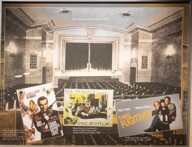
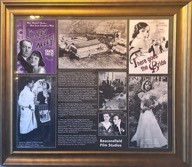
The text reads: These studios were built in 1921 by George Clark Productions. The first production was The Beauty and The Beast, written and directed by its star, Guy Newall, and co-starring his future wife, Ivy Duke. Most British studios went quiet after 1924, until 1928, when the Films Bill limited foreign films to 22.5% of the market.
There was a rush of production activity – among the new start-ups was The British Lion Film Corporation Ltd.
Edgar Wallace, the prolific thriller writer, was British Lion’s chairman. The company purchased Beaconsfield Studios in 1927, with Wallace’s story, The Ringer, being the new company’s first production, followed, in 1929, by the first all-talking feature film produced in Britain, Wallace’s The Clue of the New Pin. The Squeaker, directed by Wallace, followed in 1930. Wallace then left for Hollywood to write King Kong,
In 1939, the Ministry of Works requisitioned the studios. After the war, in 1946, British Lion was bought by Alexander Korda, who sold the studios’ freehold to King’s College, Cambridge. The Crown Film Unit moved in and produced 75 films a year for the Central Office of Information by filmmakers who included John Grierson and Humphrey Jennings, before the unit was wound up in 1951.
The Chiltern Cinema
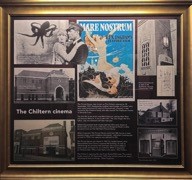
The text reads: The Picture House, later known as The Chiltern, opened on 15 September 1927. Designed by Leathart and Granger of London (who were noted architects of many of the provinces’ cinemas), it was owned by the Cheshire family, who also owned The Playhouse cinema in Gerrards Cross.
The first film to be shown was Mare Nostrum, starring Alice Terry and Antonio Moreno. It was a silent film. The Jazz Singer, the first ‘talkie’, was not released until later that year.
Before this purpose-built cinema opened, films were shown at Burkes Hall, at the corner of Burkes and Gregories Road, in what became known as The Old Silent Picture House.
When it opened, The Picture House could seat 500, but as screens became larger, accommodation decreased – and when CinemaScope arrived (in 1955), the capacity was reduced to 376.
The Picture House was closed in 1961 for modernisation, after Beaconsfield Town Council acquired the building. As well as refurbishing the entrance hall and foyer, the council added a larger stage and space for an orchestra. When it reopened on 18 November 1963, it also had a new name – The Chiltern.
Enid Blyton
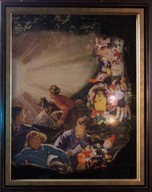
The illustrations in this Enid Blyton woodland scene show:
The Enchanted Wood, the first of The Magic Faraway Tree series, published in 1939
Noddy and Big Ears, who first appeared in a book series published between 1949 and 1963
Five Go Adventuring Again (published in 1943), the second book in the Famous Five series
Enid Blyton and her first husband, Hugh Pollock, moved in 1938 to Green Hedges, in Beaconsfield, from Old Thatch, near Bourne End. She remained living at Green Hedges until shortly before her death in 1968. The house was then demolished to make way for a development of new houses named Blyton Close.
By 1943, Enid had divorced Hugh and married surgeon Kenneth Darrell Waters.
During her years at Green Hedges, she wrote all 21 Famous Five books, as well as the Secret Seven series and the Adventure collection. In the 1950s, she created her most successful character, Noddy, who was born in Beaconsfield, with over 20 million copies of these books sold.
Enid’s garden adjoined Roland Callingham’s and Bekonscot Model Village.
She enjoyed taking her daughters Gillian and Imogen to the miniature village the other side of her garden fence (where she and Roland often met for a chat). She wrote The Enchanted Village – a little book based on the model village. In 1997, on the centenary of Enid’s birth, a scale model of Green Hedges was unveiled at Bekonscot.
Alison Uttley
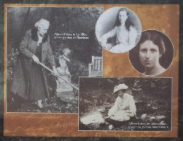
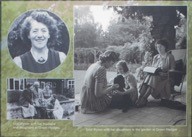
Alison Uttley, the ‘spinner of tales’ and creator of Little Grey Rabbit, lived in Beaconsfield during 1938–76.
Alison was born in 1884, in Derbyshire. In 1906, with a degree in physics, she became one of the first women to graduate from Manchester University. She was widowed while still a young mother and turned to writing, rather than relying on her teacher salary. Her first book for children, The Squirrel, the Hare and the Little Grey Rabbit, was published in 1929.
Alison moved in 1938 to Beaconsfield, the same year as Enid Blyton did. Her house, which she named Thackers, was located in Ellwood Road. She lived there until her death in 1976 and is buried in Penn churchyard. Thackers was demolished in 2024.
Alison wrote over 100 books, mostly for children. Her works for adults include the famous semi-autobiographical The Country Child, Ambush of Young Days and A Year in the Country – all drawing on her deep love for, and knowledge of, the countryside. In 1939, she also published a popular historical novel – A Traveller in Time.
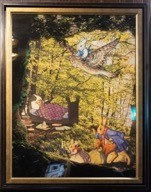
The illustrations in this Alison Uttley woodland scene show:
Little Grey Rabbit and Owl
Little Grey Rabbit holding a candle, with Squirrel and Hare, used as an illustration in The Squirrel, The Hare and The Little Grey Rabbit, 1929
Wise Owl lying in bed reading by candlelight, used as the front-cover design to Wise Owl’s Story, 1935
Robert Frost
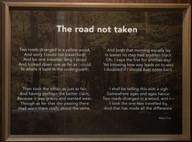
Two roads diverged in a yellow wood,
And sorry I could not travel both
And be one traveller, long I stood
And looked down one as far as I could
To where it bent in the undergrowth;
Then took the other, as just as fair,
And having perhaps the better claim,
Because it was grassy and wanted wear;
Though as for that the passing there
Had worn them really about the same,
And both that morning equally lay
In leaves no step had trodden black.
Oh, I kept the first for another day!
Yet knowing how way leads on to way,
I doubted if I should ever come back.
I shall be telling this with a sigh
Somewhere ages and ages hence:
Two roads diverged in a wood, and I
– I took the one less travelled by,
And that has made all the difference.